The Story
The short answer
Strain the drippings as soon as the turkey comes out of the pan, let them stand until the fat rises into a clean layer, and measure what you have before anything hits the stove. The gravy itself runs on one ratio: 1/4 cup of fat and 1/4 cup of flour cooked together for 1 to 2 minutes, then 2 cups of liquid whisked in hot, a little at a time. The liquid is your defatted pan juices topped up with turkey stock, and most birds need that top up. Simmer about 5 minutes, season at the very end, and serve it hot.
Most gravy trouble starts before the roux. The whisking part takes minutes and rarely goes wrong on its own. What goes wrong is quieter: drippings left sitting in the pan until they are hard to pour, fat that never fully separated, or a cook who discovers at the stove that the bird gave half a cup of juice for a gravy that needs two. The turkey gravy recipe on this site covers the roux and the simmer step by step. This guide covers the drippings themselves, from the moment the turkey leaves the pan to the moment the liquid is measured and ready.
Collect every bit while the turkey rests
The resting window is your working window. A whole turkey needs 20 minutes or more under loose foil before carving, and a breast needs about 15. That is plenty of time to deal with the pan, and the pan is easier to handle while everything in it is still liquid.
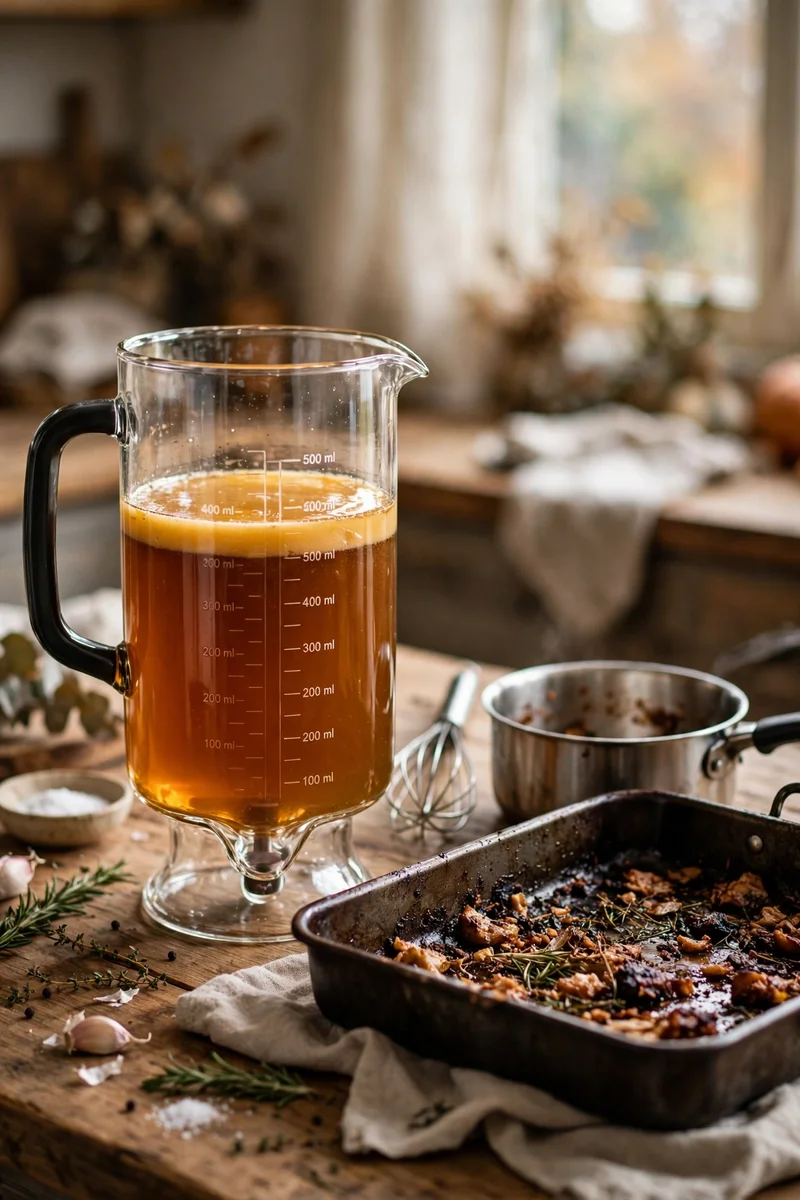
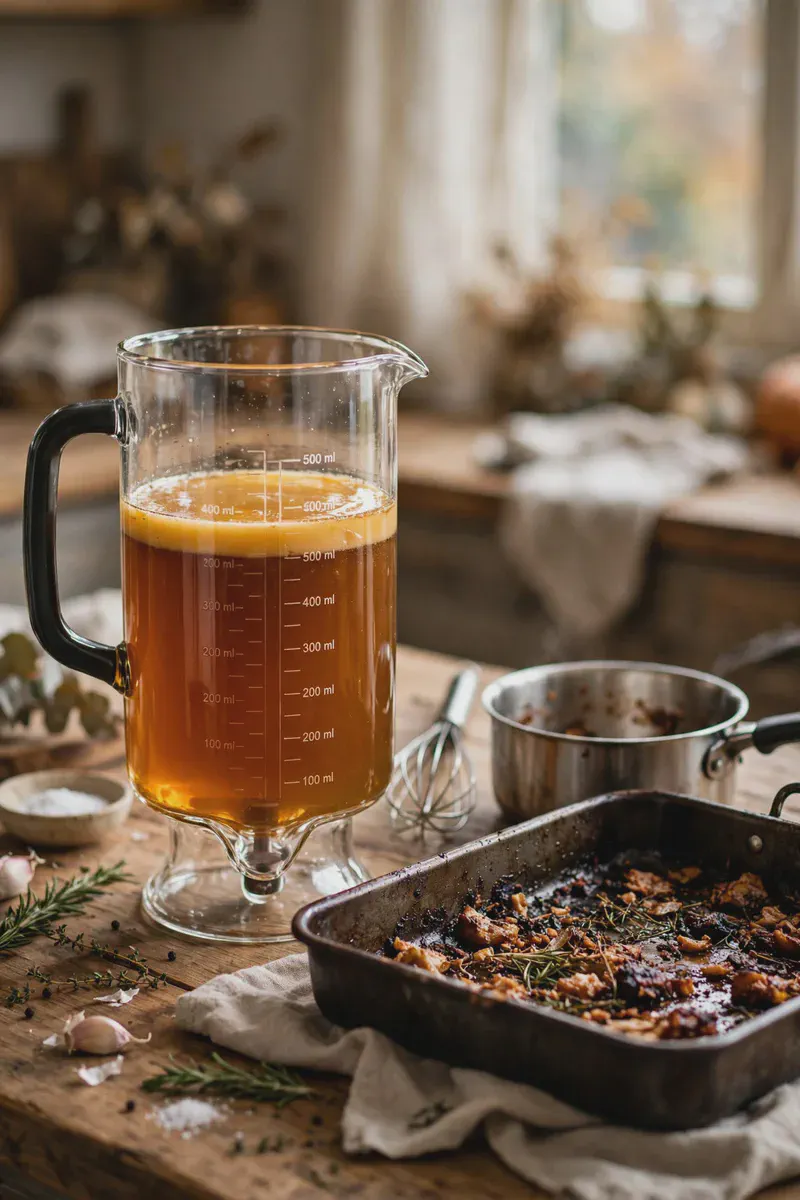
Tip the roasting pan and pour everything in it through a strainer into a fat separator or a glass measuring cup. The pan is heavy and hot, so use oven mitts on both hands, set the cup on a stable surface close to the pan, and pour slowly. Straining matters because the drippings carry bits of skin, herb stems, and loose debris that you want in the compost, not in the gravy.
Then put the empty pan back over medium heat, pour in a splash of turkey stock, and scrape the bottom with a wooden spoon. The browned layer stuck to the pan is the most concentrated flavour the turkey produced all day, and it dissolves into that splash of stock in under a minute. Pour the deglazing liquid into the cup with the rest of the drippings. A roasted bird like the apple cider glazed turkey breast leaves a sweet and savoury version of this layer, and it is worth the same minute of scraping.
One limit to respect: drippings are meat juices, and they follow the same rule as the turkey itself. Two hours at room temperature is the outer limit, so if dinner is running long, get the cup into the fridge and warm the juices back up when you build the gravy.
Separate the fat: three ways that work
Fat and juice separate on their own given a few undisturbed minutes. The fat rises, the juices settle below, and a visible line forms between them. Your job is only to get the two apart cleanly. All three methods below end at the same place, so pick by the time and tools you have.
A fat separator is the easy route. It pours from the bottom, so the defatted juices come out first and you stop pouring when the fat layer reaches the spout. If you make gravy or pan sauces more than once a year, this is the tool that earns its drawer space.
A spoon and a tilted cup work fine without one. Chill the cup briefly or just let it stand until the fat layer is firm at the edges, tilt the cup slightly, and skim the fat off the surface with a wide spoon. You will leave a little fat behind and take a little juice with it. For gravy, that trade is harmless.
The chill method suits anyone collecting drippings ahead of the cooking. Put the whole cup in the fridge for a few hours or overnight. The fat sets into a solid disc you can lift off in pieces, leaving clear juices underneath. It is the cleanest separation of the three, and it is the one to use when the bird cooks a day before the meal it is dressing.
Whichever way you go, measure both parts when you finish. You need 1/4 cup of the fat for the roux. The juices get measured next, and they are almost never the full 2 cups on their own.
How much drippings a turkey actually gives
Less than most people expect. A whole bird in the 12 to 16 lb range usually gives somewhere around 1 to 2 cups of drippings in total, fat and juices combined, and the spread is wide. A brined bird releases more liquid into the pan. A bird roasted on a rack over vegetables gives juices mixed with whatever the vegetables let go. A breast on its own gives less, often 1/2 to 1 cup in total, because there is simply less bird.
After defatting, the juices alone are what count toward your 2 cups of liquid, and for most birds that lands somewhere between 1/2 cup and 1 1/2 cups. Read that as the normal case, not a shortfall. The recipe was built expecting stock in the mix. The fat measure is the one that usually cooperates: a whole bird generally gives at least the 1/4 cup you need, and if a lean breast leaves you short, melted butter fills the measure without changing anything else about the method.
Stretch a short measure without thinning the flavour
Stretching drippings is just arithmetic with the ratio held steady. The liquid total stays at 2 cups. The defatted juices go in first, stock fills the cup to the line, and the fat and flour stay at 1/4 cup each. Gravy built this way still tastes of the bird, because the juices carry the roasted flavour and the stock mostly carries volume.
Two habits keep a stretched batch from tasting stretched. First, deglaze even a nearly dry pan. When juices are scarce, the browned layer on the pan bottom holds a larger share of the total flavour, and the splash of stock that lifts it is doing real work. Second, warm the combined liquid before it meets the roux. Hot liquid, streamed in gradually while the whisk keeps moving, is what keeps the sauce smooth, and it matters more, not less, when part of that liquid is plain stock.
To make a bigger batch, scale the ratio rather than the pan. Every additional cup of liquid takes 2 tablespoons of fat and 2 tablespoons of flour. A double batch for a crowd is 1/2 cup of each with 4 cups of liquid, and it wants a bigger saucepan and a full boil to reach its thickness.
When there are no drippings at all
It happens. The turkey is cooking at another house, the meal is being built a day ahead, or the bird went into a slow cooker and gave broth instead of drippings. The fallback is butter and stock at the same ratio: 1/4 cup of butter melted in place of the turkey fat, 1/4 cup of flour, and 2 full cups of turkey or chicken stock. Let the roux cook to a light gold rather than pale, because the extra minute of toasting replaces some of the roasted flavour the drippings would have brought. The recipe linked at the top carries the full version of this fallback, including how it keeps in the fridge.
Fixes, and why each one happens
| Problem | Why it happens | The fix |
|---|---|---|
| Thin and watery | The gravy never reached a full boil, so the flour never reached full thickening power | Back on the heat, bring it to a real boil, and simmer 1 to 2 minutes more. Still loose after that, whisk 1 tablespoon of cornstarch with 1 tablespoon of cold water and stir it in at the boil |
| Lumpy | Cold liquid, or all the liquid added at once, so pockets of flour cooked before they could disperse | Pour the gravy through a fine mesh strainer, or blend it briefly with an immersion blender. Next time, hot liquid in a slow stream with the whisk moving |
| Greasy, with fat pooling on top | The separation was rushed, or the finished gravy sat and broke | Skim the surface with a spoon, or lay a folded paper towel on top for a few seconds and lift the fat away with it. Whisk hard as it reheats to bring it back together |
| Too thick | Gravy keeps thickening as it stands, and a batch that poured well at the stove sets up on the table | Whisk in warm stock a splash at a time until it pours the way you want |
| Bland | Under salting, almost always. Stretched juices make it more likely, not less | Salt first, a pinch at a time, tasting between additions. Most bland gravy is one honest pinch from tasting like turkey |
Leftover gravy keeps 3 to 4 days in the fridge and reheats to a rolling boil, whisked smooth, without losing much. Leftover drippings are worth freezing before they are worth throwing out, and once the gravy question is settled the rest of the bird has a plan too: the leftover turkey soup takes the carcass and the last of the meat from here.