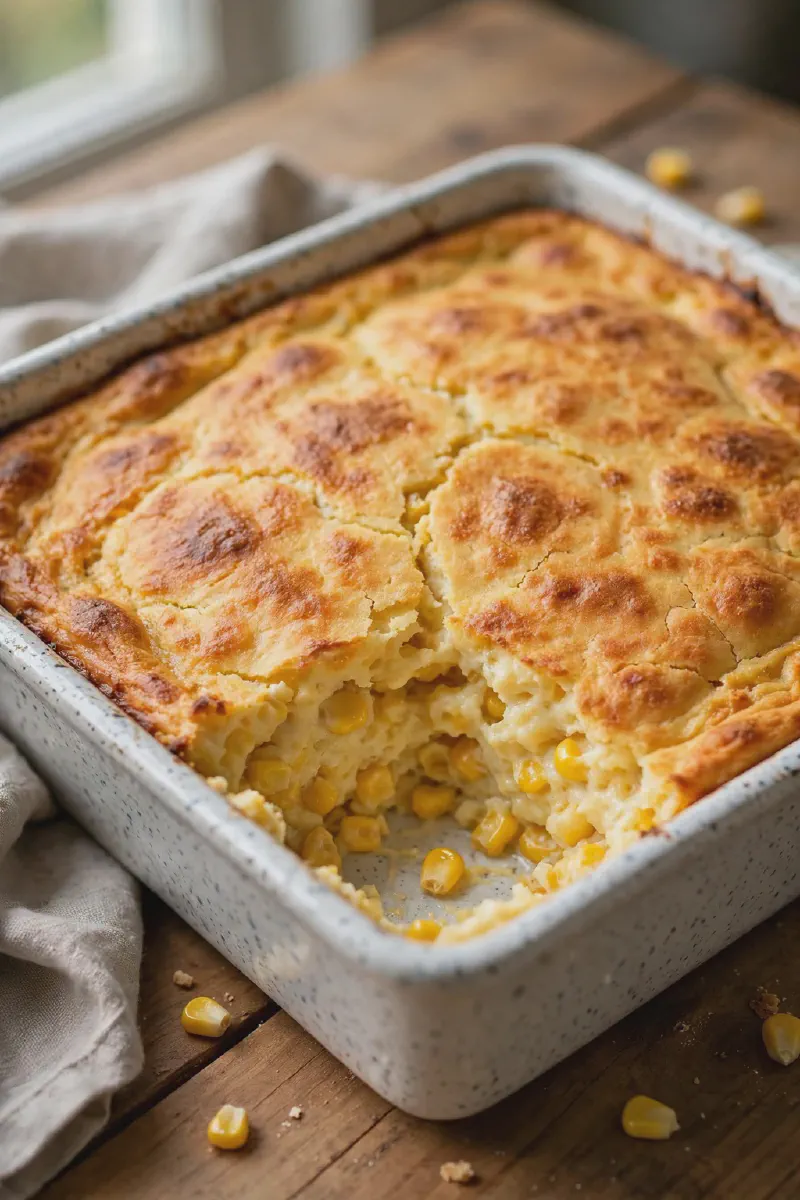
Corn casserole takes six ingredients, one bowl, and five minutes of stirring, and then the oven takes it from there. What comes out is not cornbread. It is soft all the way through, rich from the butter and sour cream, and meant to be scooped with a spoon, with a golden top that gives way to a texture close to corn pudding. Plan on 60 minutes start to finish: 5 minutes of prep, 45 minutes in the oven, and a 10 minute rest that is counted in the total because the casserole needs it to finish setting.
Two cans, two different jobs
The whole kernel corn and the creamed corn are not interchangeable, and the recipe treats them differently on purpose. The whole kernel can gets drained. Its packing liquid is mostly water, and leaving it in makes the center soupy instead of soft. The kernels themselves stay whole in the batter and give each scoop something to bite into.
The creamed corn goes in exactly as it comes out of the can, liquid and all. That liquid is part of the batter. It carries the moisture that keeps the crumb tender and, along with the sour cream, is a big reason the finished dish spoons like a pudding instead of slicing like a bread. If you drain both cans, the casserole bakes up dry and crumbly. If you drain neither, the middle may never fully set.
The mix goes in dry
The corn bread mix, an 8.5 oz package of the Jiffy style, goes straight into the bowl dry. There is no separate muffin batter to make first, no milk to add. The mix brings flour, cornmeal, leavening, salt, and a little sugar, and the wet ingredients around it, the melted butter, beaten eggs, sour cream, and creamed corn, supply more than enough liquid to hydrate it.
Stir until no dry mix remains and then stop. The eggs and the mix give the casserole just enough structure to hold a scoop shape; working the batter longer than it needs only tightens it. The batter will look loose and pourable, closer to a thick pancake batter than a dough. That is correct. It firms up in the oven, not in the bowl.
Baking and reading the center
Bake at 350°F (177°C) for 45 minutes in the 9x9 inch dish. The cues that matter are a top that has gone golden brown and a toothpick pushed into the center that comes out clean. Times are an estimate, and the variables are your oven and your dish: a glass or ceramic dish holds heat differently than a metal pan, and a casserole that went in cold from the fridge needs a few extra minutes (see the make ahead note below).
A slight softness in the very middle straight out of the oven is fine and expected. The 10 minute rest finishes the set as the casserole stands, the same way a custard keeps firming up off the heat. What is not fine is a center that still sloshes like batter when the dish is tilted. That one goes back in for 5 more minutes at a time until the toothpick test passes.
Serving, doubling, and making it ahead
Serve it straight from the dish with a big spoon, about 3/4 cup per serving, which is roughly one eighth of the pan. On a holiday table it sits comfortably next to the slow cooker sausage, apple and sage stuffing and something brighter, like the hot honey maple glazed carrots, because its job in the spread is the soft, rich one.
To double it, double every ingredient and bake it in a 9x13 inch dish. The math: one batch makes about 6 3/4 cups of batter, so a double batch is about 13 1/2 cups, which a 9x13 holds at roughly the same depth as the single batch in its 9x9. Keep the oven at 350°F (177°C) and expect 45 to 50 minutes, going by the same golden top and clean toothpick test. A double batch serves 16 at the same 3/4 cup serving size.
To make it ahead, stir the batter together, spoon it into the greased dish, cover, and refrigerate for up to 24 hours before baking. Bake it straight from the fridge and add 5 to 10 minutes to the time, checking the center with a toothpick rather than the clock. Leftovers keep in the fridge for up to 3 days; reheat a portion in the microwave, or warm the whole dish, covered with foil, in a 350°F (177°C) oven for about 15 minutes.
Questions that come up
Can I use frozen corn instead of the canned whole kernel corn? Yes, for that can only. Thaw 1 1/2 cups of frozen corn and drain it well, then use it in place of the drained whole kernel corn. Keep the creamed corn as a can; there is no frozen equivalent that brings the same liquid and body.
What if I am out of sour cream? Plain Greek yogurt in the same 1 cup amount is the closest swap. It is a little tangier and a little leaner, so the casserole sets slightly firmer and tastes slightly sharper, but the structure holds. Do not swap in milk or cream; the batter needs the thickness sour cream brings.
Can I bake half a batch? Yes. Halve every ingredient, which gives about 3 1/3 cups of batter, and bake it in an 8x8 inch dish or a 9x5 inch loaf pan at 350°F (177°C). Start checking at 35 minutes; the shallower batter sets sooner, and the same toothpick test tells you when it is done. Half a batch serves 4.